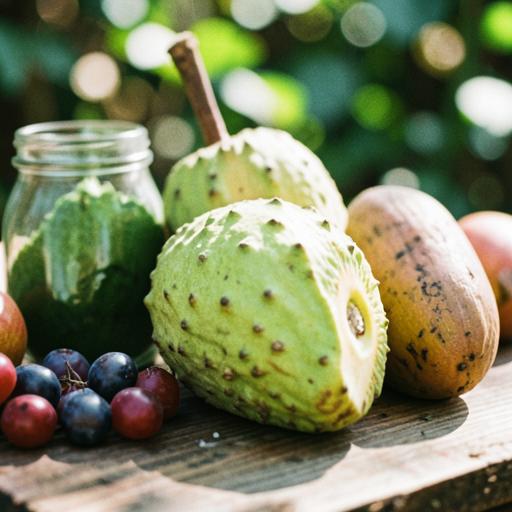
Chemistry & Compounds
The soursop is a fruit of the Annona muricata species whose main ingredient is the annonaceous acetogenins or long-chain fatty acid derivatives. These chemicals are mainly present in the Annonaceae family but are particularly concentrated in the soursop plant, where they play the role of natural insecticides. This substance has a molecular weight of about 600 Da. It is a complex molecule whose specific construction resembles the structure of inhibitors of mitochondrial complex I. The most common representative of acetagenins is annonacin. Despite the promising nature of the substance, its use in the treatment of diseases is limited by the low concentration in the body after ingestion.

Health Benefits & Effects
For traditional medicine, the soursop plant has always been famous for its healing powers. However, modern scientists are particularly interested in the unique ability of this fruit to fight cancer. Researchers have isolated several acetogenins from the leaves and fruits of the plant, which exhibit pronounced cytotoxic properties against various cancer cells. In particular, this substance inhibits the proliferation of tumor cells and reduces their viability by suppressing the formation of adenosine triphosphate. In addition, annonaceous acetogenins cause programmed cell death of malignant cells, which is extremely promising in terms of oncology. Nevertheless, despite the high level of evidence in vitro and in vivo, these beneficial effects of soursop have not been confirmed in human clinical trials.
Practical Use & Preparation
The soursop fruit is most commonly eaten raw. It has a pleasant sweet and sour taste and can be used in various ways in the kitchen. As a food supplement, it is also useful in smoothies and juices. In traditional medicine, preparations have long been known that include the bark, leaves, and seeds of the plant. However, only controlled amounts of the fruit in food are allowed since it is classified as a food product. Moreover, high concentrations of annonacin are neurotoxic, so high doses of any form of this plant are contraindicated. The preparation of soursop is very simple: the fruit is peeled and cut into slices or cubes to remove the bitter seeds. Nevertheless, caution is needed when using this product, and it is necessary to consult a doctor with knowledge of the peculiarities of pharmacology to know the acceptable doses for the body.
Safety, Interactions & Cautions
Although soursop is generally safe, this fruit has specific dangers. First, there are reports that regular consumption of the flesh or leaf infusions leads to the development of neurological diseases associated with decreased motor activity. In particular, annonacin, an acetogenin found in the soursop, has been shown to cause degenerative changes similar to Parkinson’s disease. Even more dangerous are the effects of annonacin at the level of neurons when ingested in high doses. This is especially the case when the wood, leaves, or fruits of related species of the Annonaceae family are used. Moreover, interactions between the components of the soursop and drugs that affect blood pressure, glucose levels, and blood clotting are also possible. In this regard, it is especially important for people with neurodegenerative diseases and during pregnancy and lactation to consult a physician before using this product. In addition, to estimate the effects of soursop on the body, it is necessary to start with a small dose.
History & Traditional Use
The use of soursop in traditional medicine has a long history. This fruit grows native to the American tropics, but now it is also common in Southeast Asia, Africa, and the Caribbean. Local people have used it in their folk medicine for centuries, believing in its tonic and healing properties. Moreover, all parts of the plant have been used for therapeutic purposes. In particular, decoctions and infusions of leaves, bark, and seeds have long been used in traditional medicine to treat inflammatory, parasitic, and viral diseases. The popularity of this fruit is due to its unique composition and the high content of annonaceous acetogenins, which are recognized as biologically active substances. Thus, the use of soursop in folk medicine has become widespread, and now scientists are trying to explore its useful properties.
Myths vs. Evidence
It is hard to say with a high degree of probability whether the fruit of the soursop plant is as effective as traditional medicine claims. On the one hand, this plant does have a number of useful effects that have been confirmed by modern science. On the other hand, there is no definite evidence of the complete cure of any illness. Although annonaceous acetogenins show promising results in the fight against cancer, oncologists do not recommend using this fruit as a cure for tumors. Moreover, there is a danger of overdose since soursop contains neurotoxins. This contradicts the popular belief that natural remedies are entirely safe, and therefore it is important to use this product with caution. However, the reputation of the soursop as a medicinal plant is not only due to its chemistry but also to its culinary use. The unique flavor of this fruit has made it a popular addition to the diet of local people.
References
- Anticancer Properties of Graviola (Annona muricata): A Comprehensive Mechanistic Review
- Annona muricata (Annonaceae): A Review of Its Traditional Uses, Isolated Acetogenins and Biological Activities
- Identification of the Environmental Neurotoxins Annonaceous Acetogenins in an Annona cherimolia Mill. Alcoholic Beverage Using HPLC-ESI-LTQ-Orbitrap
- Annonacin in Asimina triloba fruit: Implication for neurotoxicity